Follow the source
Investigate substantial documentary matters. Inspect supporting and conflicting material, chronology and gaps.
Explore source-linked investigation →For UK law firms · substantial documentary matters
Investigate the evidence. Connect junior preparation to its sources. Keep solicitor review and professional decisions visible.
Explore without signing in. Demonstrations use fictional material. AI-assisted work requires professional review.
Three connected capabilities
Investigate substantial documentary matters. Inspect supporting and conflicting material, chronology and gaps.
Explore source-linked investigation →Connect assigned preparation to original evidence, correction requests and versioned submissions.
Explore Junior Workspace →Distinguish AI assistance, junior preparation and human review. Inspect the evidence before relying on the work.
Review governance and assurance →FEATURED WORKFLOW · JUNIOR WORKSPACE
From task assignment and source inspection to a qualified note, corrections and supervisor review—within the existing governed matter workspace.
Shown using a fictional training matter. Professional approval is separate.

A practical evaluation journey
Follow a fictional evidence conflict and its recorded review route. No upload or client material.
Explore the synthetic example →Choose source investigation, junior supervision or governance. We arrange application access separately.
Request a walkthrough →Set the workflow, assurance requirements and success criteria before deciding whether a pilot fits.
Review the evaluation approach →Independent practising-solicitor validation, measured productivity savings and security certification are not claimed.
The practical test: can an unfamiliar documentary matter be investigated while keeping contradictory material, sources and professional decisions visible?
Find the documents that support and undermine a disputed proposition, plus uncertainties and unanswered questions.
Check context, provenance, dates and missing sources, not just plausible quotations.
Assess professional usefulness, costs and the security gates before confidential material is introduced.
Independent practising-solicitor acceptance and independent security clearance are not yet claimed.
Document lineage · connected evidence
Revised contracts, amended reports and competing drafts can affect the work built on them. LegalRAG Pro connects document versions while preserving the original sources and citations, helping your team inspect the consequences of an approved version relationship.
Record which document revises or supersedes another. Review suggested relationships before approval, and keep competing branches visible.
Keep earlier sources, their hashes and citations available for inspection. A newer version does not erase the evidential record.
Check recorded links from the predecessor's evidence to issues, chronology, findings, tasks and drafts, so the team can decide what needs review.
Watch Document Lineage · 3:32 →
Practitioner approval controls document relationships. Impact analysis is read-only; it does not automatically update case work or determine a document's legal effect.
New: Document Change Impact
A revised source can affect a legal issue — and tasks linked to that issue, even when the tasks do not cite the source directly. LegalRAG Pro highlights these indirect issue-to-task connections alongside directly linked review items, without inventing direct citations or changing approved conclusions.
Read-only impact analysis; no automatic legal conclusions or task approvals. Controlled synthetic acceptance has passed; a complete populated-matter authenticated browser demonstration remains to be verified.
A connected working method
Connect documents, chronology, people and issues. Keep supporting, qualifying and contradictory evidence visible.
Use Ask for bounded questions and Case Operator for defined investigations. Inspect the sources and the limits of the returned work.
Carry work into tasks, drafts and reports. The solicitor decides what is accepted, relied on, circulated or filed.
Source linkage supports checking. It does not make an AI conclusion automatically correct.
Explore the litigation workflows
LegalRAG Pro helps solicitors and litigation teams investigate substantial documentary matters while keeping source material, uncertainty and professional decisions visible. Explore the capabilities that matter to your team.
All AI-assisted findings and working outputs require legal practitioner review. These descriptions do not claim automated legal correctness.
The business case for litigation teams
Explore how supervised, source-linked work could increase team capacity. Review illustrative economics and the six-week evidence-led pilot proposal—not unverified savings claims.
Financial scenarios are illustrative, not independently measured LegalRAG Pro results.
Professional control
Source checking, supervision and confidentiality matter throughout an AI-assisted workflow. LegalRAG Pro keeps source evidence, proposed work and professional decisions distinguishable.
The SRA's 17 August 2026 warning notice provides the regulatory context. LegalRAG Pro does not claim SRA approval, certification or automatic compliance.
Finance inside the matter
Review historical financials, comparables, deterministic calculations, source evidence and limitations alongside the legal record. Core arithmetic is performed in code, and Finance AI works against frozen authority.
Confidentiality & data protection
LegalRAG Pro uses layered controls for confidential documentary work and states the remaining assurance limits openly.
Production matter storage is encrypted at rest. Encrypted off-site backup is in place, and an isolated restore of backed-up application data has been successfully verified.
TLS protects traffic to the application. Authentication, an application admission allowlist, matter membership and roles are used to restrict who can reach each matter.
LegalRAG Pro sends governed OpenAI API requests with store=False, and API training use is disabled. Under the current standard profile, abuse-monitoring logs may retain customer content for up to 30 days. Zero Data Retention has been requested from OpenAI but is not yet approved or claimed.
Confidential or privileged client use remains subject to a controlled pilot, appropriate customer data-protection arrangements and independent security assurance. No Zero Data Retention claim is made until OpenAI approval is enabled and evidenced.
Choose a first view
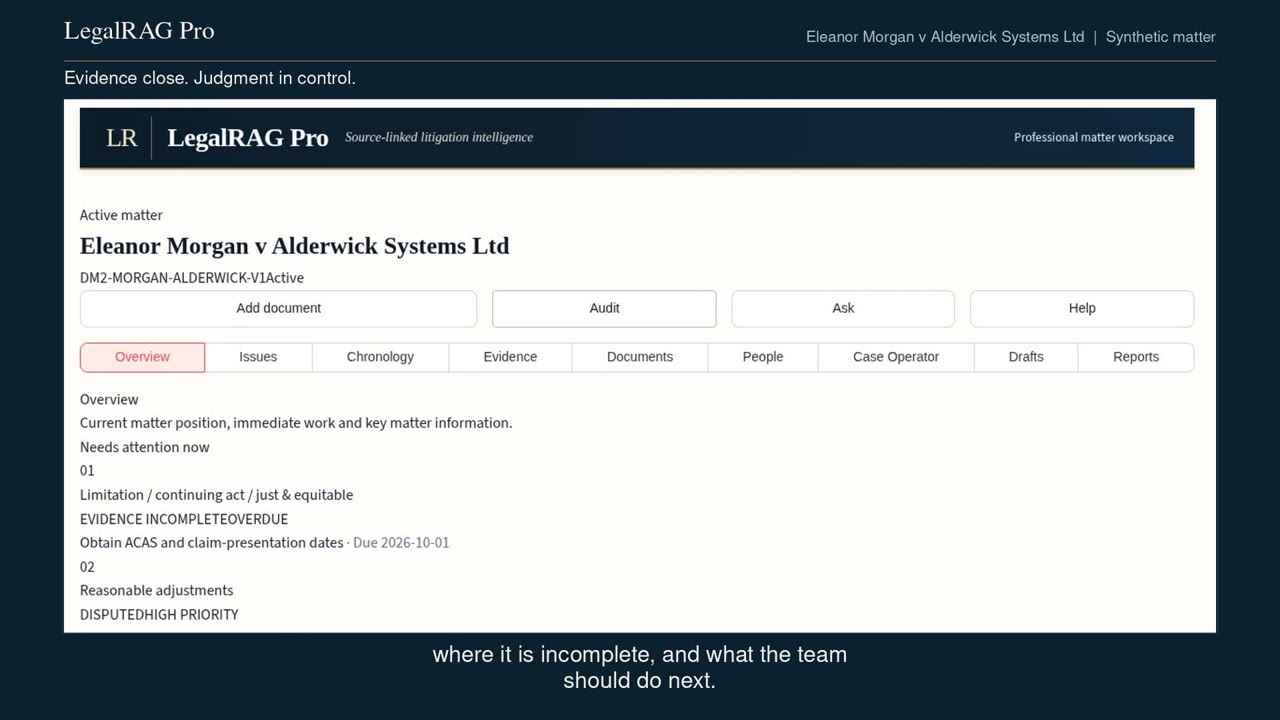
A concise introduction to the working method.
Watch the overview →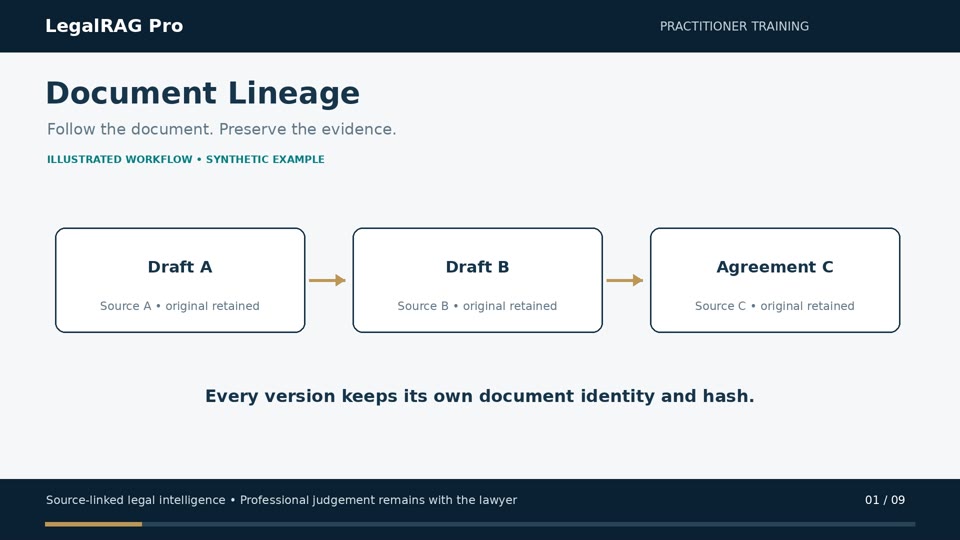
Versions, preserved evidence and downstream impact.
Watch document lineage →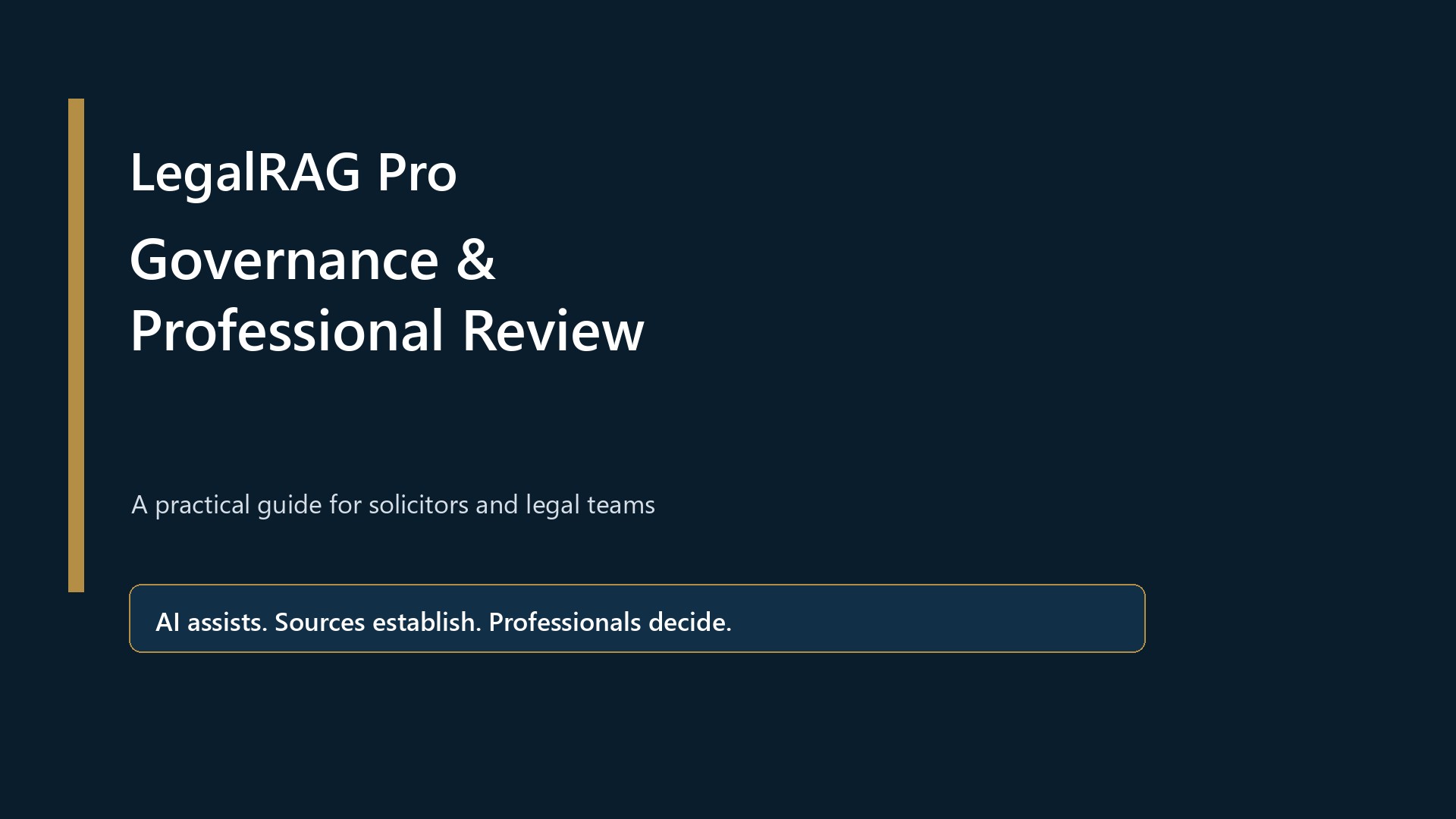
Review controls and the professional decision.
Watch governance →Watch the full practitioner workflow · 9:11 → or choose from the ten focused workflows →.
short case challenge
Choose an issue. LegalRAG does not reward the “right” answer; it shows what the current evidence state says and what still needs professional attention.
The synthetic matter records missing ACAS and claim-presentation dates as an explicit task. The issue is visible as incomplete rather than being smoothed into a confident answer.
The record moves through occupational-health advice, adjustment discussions, attendance requirements, capability concerns and disputed meeting material. The task is to inspect what supports, qualifies or contradicts the proposed account.
The frozen synthetic report records stronger support for employer knowledge than for some other issues. LegalRAG keeps the evidence route available so the solicitor can verify what the assessment rests on.
Synthetic demonstration status only. These are working evidential positions, not legal determinations.
A practical first step
Book a practitioner walkthrough to explore source review, document lineage, investigation or Finance. Then agree whether a scoped pilot fits your team.
No client material is needed for the walkthrough. Application access is arranged separately.
Solicitors, litigation teams and their colleagues working on substantial documentary matters, where evidence, chronology, versions and review need to stay connected.
Yes. The walkthrough uses synthetic material. Confidential or privileged use requires agreed information boundaries, appropriate processing arrangements and security due diligence.
No. AI-assisted findings, proposed work and working drafts remain subject to source checking and professional judgement.